
Knowledge and research
What frankincense actually does, when you burn it.
This page exists because you deserve concrete answers. What the resin is, which compounds the smoke carries, what modern science actually shows, and which health concerns are real versus the result of confusing frankincense with something else.
Every sentence here that names a molecule or a physiological effect carries a citation, with a quoted passage from the paper so you can verify it yourself.
Nothing on this page is medical advice. If you have any diagnosis affecting your airways or allergies, or if you are pregnant, please talk to a clinician before introducing any new smoke into your home, including frankincense.
Section 1
The tree the resin comes from

Frankincense as we know it comes from Boswellia sacra — a small, thorny tree that grows in very specific conditions: the limestone hills of Dhofar in Oman, the low monsoon clouds of khareef for three months a year, the mineral soil and the burning sun of the rest. The tree looks like something barely holding on. That is exactly why it produces resin.
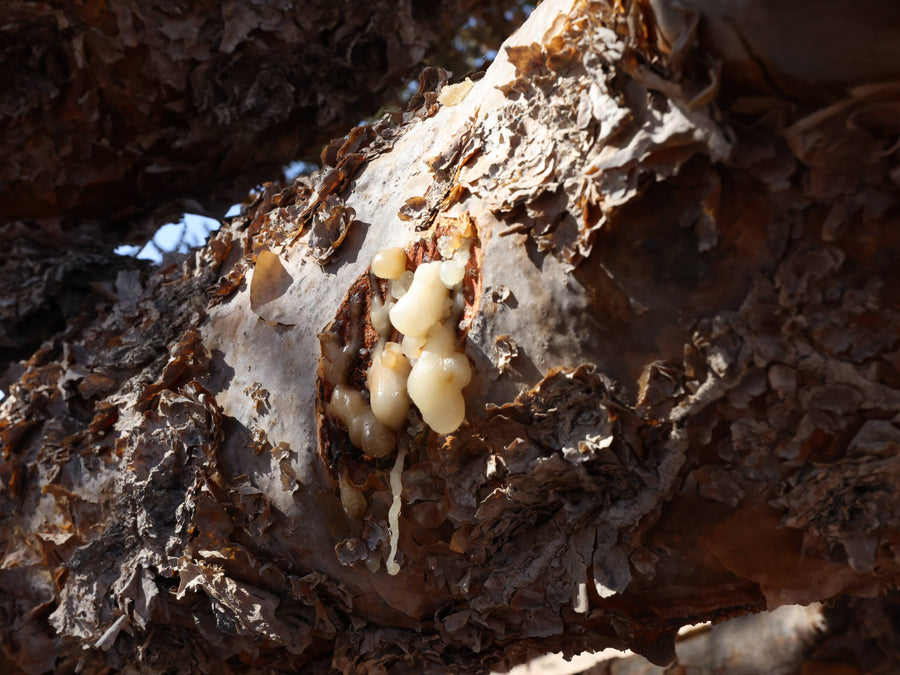
When the bark is cut with a sharp tool, the tree weeps a milky exudate that hardens in air into amber and jade-coloured "tears." It is not sap and it is not syrup — it is a defence mechanism against insects and fungi. All of the pharmacology we are about to name is the tree's ancient toolkit of chemical self-defence, repurposed by people who noticed it did useful things for them too.
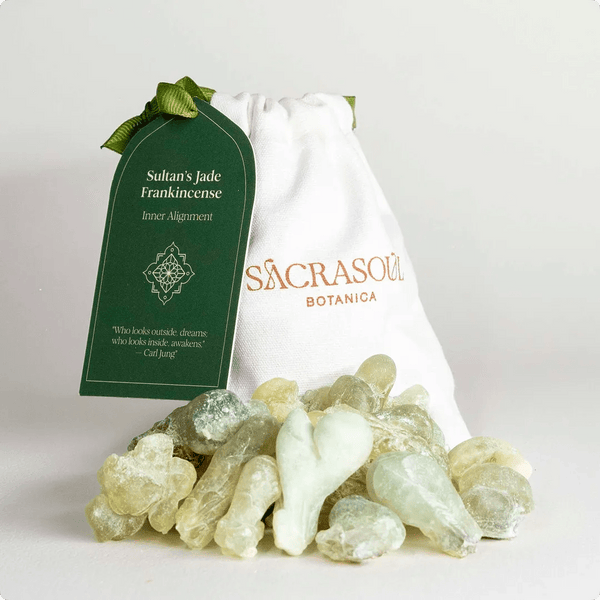
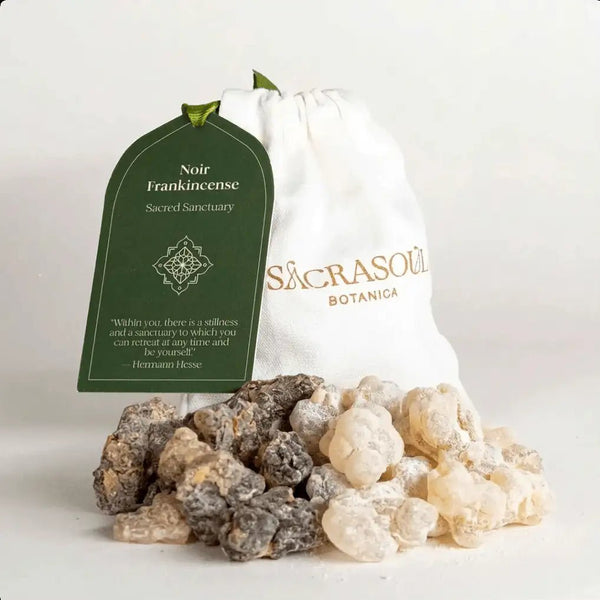
The rarest grade — Royal Hojari, the jade-coloured tears — is sorted by hand. From roughly four hundred kilograms of raw resin, only about one kilogram reaches the colour, clarity, and bright citrus aroma that mark Royal Hojari. The ratio is not fixed: it moves with the year, the harvest, and how the season treated the trees. The rest sorts into lower grades: amber Hojari, black Hojari, and everyday blends. All come from the same tree species. They differ by tap age, cut position, and harvest timing.
Section 2
What is actually in the resin
Boswellia sacra produces hundreds of small molecules. Two families matter for everything we describe on this page:
Boswellic acids (most studied: AKBA)
AKBA = 3-O-acetyl-11-keto-β-boswellic acid · C32H48O5
Pentacyclic triterpenoids. AKBA is the best-studied — it selectively inhibits the enzyme 5-lipoxygenase (5-LOX), which initiates the leukotriene branch of the inflammation cascade. It does not inhibit cyclooxygenase. In plain English: it blocks one specific turn in the chemistry of inflammation, not all of it.
Up to 1–3% of the dry mass of the resin. Clinical doses in human inflammatory-disease trials typically run 300–400 mg per day of standardised extract, taken by mouth.
Incensole acetate (and incensole itself)
Incensole acetate · C22H36O3 · cembrane diterpene
A cembrane-family diterpene. Present in the resin at much lower concentrations than the boswellic acids — but unlike them, it is volatile. That means it is in the smoke. It activates TRPV3 ion channels in the brain, the same channels that respond to gentle warmth on skin. The Moussaieff group showed in 2008 that it produces anxiolytic and antidepressant-like behaviour in mice.
Around 1–8% of the resin by mass, depending on grade. Volatilises into the smoke above roughly 80°C.
Other compounds — α-pinene, limonene, terpene acetates — carry the bright resinous-citrus aroma. On their own, none produces measurable neurochemical effects at inhalation doses. Combined with incensole, they give what temples and Omani kitchens learned to use thousands of years ago.
Section 3
What happens, step by step, when you burn it
Resin meets heat
A tear of resin on hot charcoal begins to melt. Volatile compounds, including incensole acetate, evaporate into the air. Boswellic acids, being heavier, mostly stay in the resin.
Smoke reaches the limbic system
Your nose passes the molecules directly to the olfactory system and into the limbic brain — the ancient part of your brain that handles emotion and memory. The route bypasses the prefrontal cortex; the response is immediate, not analytical.
The body responds
Incensole acetate activates TRPV3 channels in the brain — in mouse studies (Moussaieff et al. 2008) this produced anxiolytic behaviour. The shoulders drop. The breath lengthens. Something settles.
What we subjectively call "calm" or "stillness" when burning frankincense is the layering of two mechanisms: the well-known aromatherapy route (scent molecules → limbic system → stress-response modulation) and a frankincense-specific TRPV3 activation from incensole acetate. The second mechanism is what no other smoke or candle has, and it is why temples chose this resin and not something else.
Section 4
What the science actually says — with the quotes
Here are the original findings from peer-reviewed papers, in the authors' own words. Links open the full papers on PubMed/PMC.
Incensole acetate and the brain
Incensole acetate, isolated from Boswellia resin, causes anxiolytic-like and antidepressive-like behavioural effects in wild-type mice with concomitant changes in c-Fos activation in the brain. These behavioural effects were not noted in TRPV3(-/-) mice, suggesting that they are mediated via TRPV3 channels. Moussaieff A, Rimmerman N, Bregman T, et al. (2008). FASEB Journal 22(8):3024-34. Ref 2
This is one of the strongest papers linking a specific compound from the resin to a specific brain ion channel. A mouse study, not a human study — but performed on transgenic mice lacking TRPV3, which gave clear mechanistic evidence: the effect disappears when the channel is missing.
Boswellic acids and inflammation
Acetyl-11-keto-β-boswellic acid (AKBA) is the most potent inhibitor of 5-lipoxygenase product formation in the boswellic acid family. The inhibition is selective, enzyme-directed, non-redox and non-competitive… Boswellic acids do not inhibit cyclooxygenases or 12-lipoxygenase. Ammon HPT (2006). Planta Medica 72(12):1100-1116. Ref 3
Ammon synthesises three decades of German laboratory research on Boswellia serrata (the Indian sister species of Omani sacra) and finds a reproducible mechanism: boswellic acids selectively block 5-LOX. That enzyme produces leukotrienes — strong inflammatory mediators responsible for bronchoconstriction in asthma and for some joint pain in inflammatory arthritis.
Boswellic acids — especially AKBA — modulate inflammation through diverse mechanisms spanning key signalling pathways including NF-κB, MAPK, 5-LOX, COX-2, and the NLRP3 inflammasome, as well as modulation of cytokines, immune cell activity, and oxidative stress. Peng C, Yang Y, Wang Y, et al. (2025). Frontiers in Pharmacology. Ref 4
The modern update. Peng et al. describe that beyond the classical 5-LOX inhibition, AKBA shifts macrophage populations from a pro-inflammatory state (M1) towards an inflammation-resolving state (M2). This is a newer angle: not just "block the fire" but "actively direct the cleanup."
Stress and cortisol
Frankincense essential oil reduced corticosterone in sleep-deprived rats. The major component terpenes alone (α-pinene, limonene) elevated stress hormone, while the full essential oil produced the calming effect, suggesting the activity is in the whole extract rather than any single isolated component. Okano S, Honda Y, Kodama T, Kimura M (2019). Journal of Oleo Science 68(10):1003-1009. Ref 5
A rat study, not a human study. But two details matter: (1) the cortisol-reducing effect appears with the whole extract, not with isolated terpenes; (2) sleep-deprived animals are a standard model of physiological stress. Human randomised trials of inhaled frankincense and cortisol in healthy volunteers do not yet exist in numbers that would support a meta-analysis. Other essential oils (lavender, bergamot, fennel) do have randomised trials showing salivary-cortisol reductions of 37–54%. We combine these three sources: rodent + broader-class evidence + six thousand years of continuous use.
Section 5
Smoke, particulates and the respiratory question
Every honest answer about whether burning anything is safe for your lungs starts with the same sentence: combustion produces fine particles. A lit candle does. A wood-fired oven does. Frankincense resin does too. The fair question is not whether particulate matter exists. It is whether this particulate, in this use pattern, is something a healthy adult should worry about.
Two things to hold at the same time.
First, the historical answer. Frankincense has been burned in homes, temples, churches, mosques, and synagogues for more than six thousand years. The Egyptians, the Babylonians, the Greeks, the Romans, every major Christian tradition, Yemeni and Omani households, Indian Ayurvedic practice — all of them. If sacred frankincense smoke produced epidemiologically significant respiratory harm at the doses people actually use, that harm would have been recorded somewhere across six millennia of continuous human use. It has not. The longest-running natural experiment in human history quietly cleared this product.
Second, the modern answer. Most published studies on "incense smoke and respiratory effects" looked at commercial Asian stick incense — wood-flour binders, bamboo cores, synthetic perfumes, and resin together — burned for hours daily in poorly ventilated spaces. That smoke is a different product. Pure Boswellia resin on charcoal, burned for ten or twenty minutes in a ventilated room, produces a measurably cleaner combustion profile because the fuel is the same single molecular family across the whole burn.
Practical guidance:
- Burn in a ventilated room. Open a window. Even one inch is enough to keep airflow continuous.
- Use small pieces. A grain or two at a time, not a tablespoon.
- Sessions are short and intermittent. Most users burn for 10-20 minutes once or twice a day. Not all day.
- If you're sensitive to smoke or live with someone who is (asthma, reactive airways, infants, birds), use the mica plate option. Sacrasoul's bundles include three mica plates so you can warm the resin on top of the charcoal instead of burning it directly. The boswellic acids and incensole acetate volatilise; the visible smoke is reduced to a fraction.
- If you have a diagnosed respiratory condition, talk to your clinician before introducing any new smoke into your home, including frankincense. We will never push you to burn anything you shouldn't.
The mica-plate option exists because we take the question seriously. The historical context exists because six thousand years of evidence is real evidence. The honest middle is: this is not zero-risk (nothing combustible is). For healthy adults in ventilated rooms using small amounts, it is low-risk in a way modern science and ancient practice both support.
Section 6
Common questions
Can I really drink it?
Yes. In Oman, "frankincense water" has been a traditional drink for centuries — a small piece of clean resin steeped overnight in warm water, sipped in the morning. The taste is subtly sweet and slightly woody. Boswellia has been taken internally in Ayurveda and traditional Chinese medicine. Start with a small amount. This is not medical advice.
How long does a single tear burn for?
A small tear on a glowing charcoal disc burns for five to twelve minutes. A larger piece or blend can run up to forty minutes. Several short sessions are better than one long one.
Does it work faster after I have burned it for a while?
Subjectively, yes — this is classical conditioning. Your brain learns that the smell of frankincense means quiet time. After a few sessions the response begins as soon as the scent appears, before the molecules even reach your limbic system. That is memory at work, not new chemistry.
Is it safe during pregnancy?
There are no clinical trials confirming the safety of inhaling frankincense during pregnancy. Classical caution applies: anyone pregnant or breastfeeding should talk to their clinician before introducing any new smoke exposure.
Are frankincense and myrrh the same thing?
No. Both are resins from trees in the same region (the Arabian Peninsula and the Horn of Africa), but myrrh comes from Commiphora myrrha, and frankincense comes from Boswellia sacra. Myrrh is heavier, more balsamic, earthier. Frankincense is lighter, more citrus-bright. The Magi brought both — and gold.
References
Full references
- Moussaieff A, Rimmerman N, Bregman T, et al. (2008). Incensole acetate, an incense component, elicits psychoactivity by activating TRPV3 channels in the brain. FASEB Journal 22(8):3024-34. brain
- Sowndhararajan K, Kim S (2022). Relaxation effects of essential oils are explained by their interactions with human brain neurotransmitter receptors and EEG rhythms. ACS Chemical Neuroscience. brain
- Ammon HPT (2006). Boswellic acids in chronic inflammatory diseases. Planta Medica 72(12):1100-1116. inflammation
- Peng C, Yang Y, Wang Y, et al. (2025). From bench to bedside, boswellic acids in anti-inflammatory therapy — mechanistic insights, bioavailability challenges, and optimization approaches. Frontiers in Pharmacology. inflammation
- Okano S, Honda Y, Kodama T, Kimura M (2019). The effects of frankincense essential oil on stress in rats. Journal of Oleo Science 68(10):1003-1009. stress
- Cohen R, Sexton KG, Yeatts KB (2013). Hazard assessment of United Arab Emirates (UAE) incense smoke. Science of the Total Environment. smoke
- Lin TC, Krishnaswamy G, Chi DS (2008). Incense smoke: clinical, structural and molecular effects on airway disease. Clinical and Molecular Allergy 6:3. smoke
- Yadav VS, Mishra KP, Singh DP, Mehrotra S, Singh VK (2005). Immunomodulatory effects of curcumin. Immunopharmacology and Immunotoxicology. context
